REBA method: whole body ergonomic assessment step by step
Many risk assessments repeat the same slip: a whole body task, with twists, loads and deep bends, measured with a tool built for the arm at a fixed workstation. The result then falls short and the measures arrive late. For that kind of task there is a tool of its own, the REBA method.
This guide explains what the REBA method measures, how to apply it step by step and how to read its score from 1 to 15. It also clears up how it differs from RULA, beyond the quick answer people usually give.
What the REBA method is and what it assesses
The REBA method (Rapid Entire Body Assessment) measures whole body postural load by observation. Sue Hignett and Lynn McAtamney created it and published it in Applied Ergonomics in the year 2000. It was born to cover what RULA could not reach: dynamic, unstable or hard to predict postures, with handling of loads and even of people. In fact, healthcare was the setting that inspired its development.
The REBA method scores trunk, neck and legs in Group A, and arm, forearm and wrist in Group B. It also adds three factors that RULA leaves out or treats in a very limited way: the load or force, with an extra penalty if it comes on suddenly; the quality of the grip; and the type of activity, whether a static posture, frequent repetition or quick and unstable changes.
When to use the REBA method
The REBA method is the right pick when the task moves the whole body and the posture keeps shifting: warehousing and logistics, construction, maintenance, cleaning, hospitality and, very clearly, the health and social care sector.
For patient handling there is also the MAPO method, which adds work organisation to the postural snapshot. Sound ergonomics management in hospitals rests on both. The ergonomics section of Prevencion Integral carries articles and cases on this kind of risk in hospitals and care homes.
By contrast, if the task is anchored to a bench or a screen and the risk sits in the arm, the RULA method is still the sharper choice. And when lifting itself leads, with its weight, its distances and its frequency, the analysis moves to the NIOSH equation.
How to apply the REBA method step by step
- Watch the task and pick the postures. The REBA method starts by looking at the whole cycle. You then pick the worst postures or the most typical ones. In variable tasks it helps to assess several, and if the two sides work in different ways, assess both.
- Score Group A: trunk, neck and legs. First you score the trunk and neck angles, with corrections for twist or side bending, and the support and bend of the legs.
- Add the load or force. Group A then takes whatever the handled weight adds, with one extra point if the force comes on suddenly.
- Score Group B: arm, forearm and wrist, with corrections for abduction, a raised shoulder and arm support.
- Add the grip. You also rate how the hand fits the load: good, fair, poor or unacceptable. This is one of the contributions the method brought of its own.
- Cross the tables and add the activity. Marks A and B combine in table C, and the result takes the activity on top: static posture, frequent repetition or wide and unstable changes. The final value of the REBA method runs from 1 to 15.
Reading the score: risk levels
| REBA method score | Risk level | Action |
|---|---|---|
| 1 | Negligible | None needed |
| 2-3 | Low | May be needed |
| 4-7 | Medium | Needed |
| 8-10 | High | Needed soon |
| 11-15 | Very high | Needed now |
Each band marks how urgent the action is, although it does not explain the cause. For that you have to look at the breakdown by groups.
Practical example: restocking in a warehouse
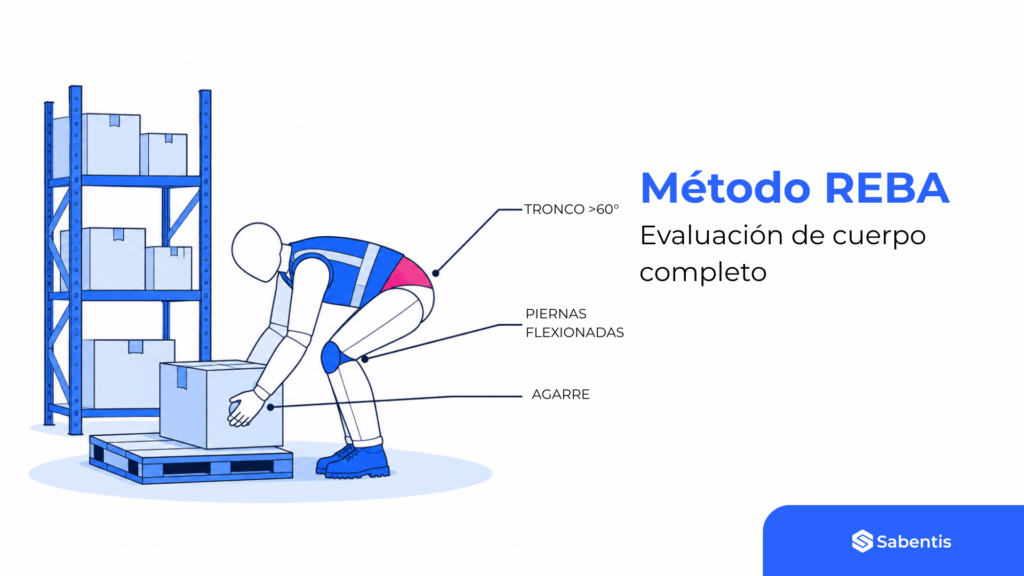
Here is how the REBA method works in a real case. An operator picks up boxes of about 9 kg from a pallet resting on the floor and puts them on a middle shelf. As he takes the box, the trunk bends more than 60 degrees and twists a little, the neck drops and the legs bend. Later, as he sets it down, the arm rises. The grip is fair because of the size of the box, and the cycle repeats many times per shift.
Deep trunk flexion with a twist pushes Group A up. The load then adds, the fair grip penalises and the repetition brings activity on top. So the case lands in the high band of the table, with a high risk level and action needed soon.
The number is not the only thing that counts. The breakdown of the REBA method shows where to act: raise the pallet to remove the deep bend, improve the grip and cut the frequency. After each measure you can assess again. The exact values must always come from the tables of the original method.
REBA method or RULA: a decision table
| Feature of the task | Recommended method |
|---|---|
| Whole body on the move | REBA |
| Unstable or shifting postures | REBA |
| Handling of loads or of people | REBA |
| Grip has to be rated | REBA |
| Task anchored to a bench, a desk or a screen | RULA |
| Risk concentrated in the upper limb | RULA |
The rule fits in one line: if the body moves or the load weighs, pick REBA; if the body stays still and the risk lives from the elbow upwards, pick RULA. The full map of tools by risk factor sits in the guide to ergonomic assessment methods.
Reliability between observers: the real limit
The REBA method leans on a technician working out angles by eye, often in postures that last only a few seconds. The literature on observation tools reports that agreement between technicians varies, above all when training is thin. Two people can score the same posture with different action levels, and that changes the order of the measures.
How to automate postural assessment with video
Automation fixes exactly that weak spot. Computer vision systems work out the angles from a video and apply the criteria of the REBA method the same way every time. At Sabentis, the AI posture analysis in the Ergonomics module runs on a video shot with a phone, with no sensors and no extra kit.
The International ORP Foundation gathers many use cases in its congresses and publications, so it is a good source for following the topic.
Frequently asked questions
What is the difference between RULA and the REBA method?
RULA measures the upper limb in static tasks or tasks anchored to the workstation. REBA covers the whole body and accepts dynamic postures, loads and grip. Each one fits a different situation, so they do not compete.
What score range does REBA use?
The score runs from 1 to 15 and splits into five risk levels: negligible, low, medium, high and very high.
Does the REBA method suit healthcare?
Yes, and the REBA method was in fact born out of watching the unpredictable postures of care work. To measure the risk of moving patients, MAPO completes the picture.
Does REBA assess the lifting of loads?
It takes the load into account as a factor of the posture, although it does not go into the detail of the lift: distances, frequency or twist. The NIOSH equation covers that, or in Spain the INSST Technical Guide.
From data to risk management
Do you want to see an assessment with the REBA method worked out on its own from a real video of your workstations? Request a Sabentis demo and we will run it on your own case.
Need to apply the REBA method across many workstations?
Sabentis works out the REBA score, ranks the workstations by risk level and leaves the report ready to sign.
Request your demoA guided 30 minute demo. No strings attached.